Chicago Boyz


  •   Problem? Question?
  •   Contact Contributors:

  •   Please send any comments or suggestions about the book that Lexington Green and James C. Bennett are currently writing to:

  • CB Twitter Feed
  • Lex's Tweets
  • Jonathan's Tweets
  • Blog Posts (RSS 2.0)
  • Blog Posts (Atom 0.3)
  • Incoming Links
  • Recent Comments

    • Loading...
  • Authors

  • Notable Discussions

  • Recent Posts

  • Blogroll

  • Categories

  • Archives

  • Archive for the 'Okinawa 65' Category

    Operation Zipper, Sept 9, 1945 — The Other “Invasion That Never Was”

    Posted by Trent Telenko on 9th September 2011 (All posts by Trent Telenko)

    Print This Post Print This Post

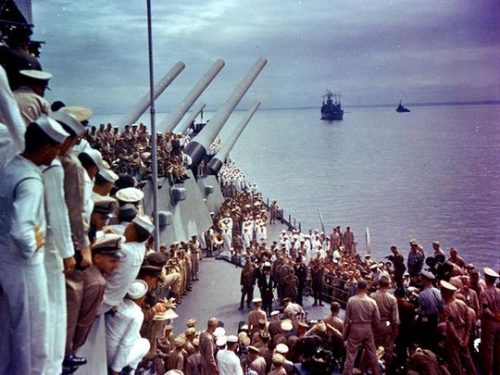
    Sixty six years ago today, had Japan not surrendered to the Allies after the dual A-Bomb attacks and the Soviet Invasion of Manchuria, the armed forces of the British Empire would have stormed the western beaches of Malaya at Port Dickson and Port Swettenham with two infantry divisions, one infantry brigade, lead by a regiment of DD-tanks and flame throwing landing vehicles. This invasion would have set off a chain of events that would have seen hundreds of thousands, if not millions, murdered and killed before the Allies put down the Imperial Japanese Armed Forces, starting with Allied Prisoners of War. The word of that atrocity would have prevented a later Japanese surrender as the British and American public’s rage would have left the American President and British Prime Minister no other options.

    This is was a very near run thing as Britain’s ambassador to Japan Hugh Cortazzi (1980 to 1984) said here:

    On Aug. 15, 1945, the Japanese authorities “announced that although Nippon had agreed to unconditional surrender, Field Marshal Count Terauchi, Commander in Chief of the Southern Army, did not associate himself with it and intended to fight on. What we did not know then was that a plan existed at Count Terauchi’s Saigon headquarters to execute all prisoners in case of invasion.”

    This passage on page 573 of “Tennozan: The Battle of Okinawa and the Atomic Bomb by George Feifer, makes clear the human cost of that “Kill All” order being executed:

    “After the fall of Okinawa, Field Marshal Count Hisaichi Terauchin issued an order directing his prison camp officers to kill all their captives the moment the enemy entered his southeast Asia theater. That would have been when those 200,000 British landed to retake Singapore, less than three weeks after the Japanese surrender. There was a real chance that Terauchi’s order would have been carried out, in case up to 400,000 people would have been massacred.”

    And it would not have stopped there. When the British reached Singapore, it would have found a repeat of “The Rape of Nanking without wartime censorship being able to cover it up. More importantly, Allies Ultra and Magic code breaking let Allied leaders know this was on the table.

    From Truman’s August 9, 1945 Radio Report to the American People on the Potsdam Conference.


    I realize the tragic significance of the atomic bomb.
     
    Its production and its use were not lightly undertaken by this Government. But we knew that our enemies were on the search for it. We know now how close they were to finding it. And we knew the disaster which would come to this Nation, and to all peace-loving nations, to all civilization, if they had found it first.
     
    That is why we felt compelled to undertake the long and uncertain and costly labor of discovery and production.
     
    We won the race of discovery against the Germans.
     
    Having found the bomb we have used it. We have used it against those who attacked us without warning at Pearl Harbor, against those who have starved and beaten and executed American prisoners of war, against those who have abandoned all pretense of obeying international laws of warfare. We have used it in order to shorten the agony of war, in order to save the lives of thousands and thousands of young Americans.
     
    We shall continue to use it until we completely destroy Japan’s power to make war. Only a Japanese surrender will stop us.

    Emperor Hirohito took the hint and sent a personal representative known to Field Marshal Count Terauchi to get the Count to enforce a surrender on his troops.

    11 Sep 2011 UPDATE (Below the Fold)
    Read the rest of this entry »

    Posted in Britain, History, Japan, Military Affairs, Okinawa 65, USA, Uncategorized, War and Peace | 12 Comments »

    Happy V-J Day!

    Posted by Trent Telenko on 14th August 2011 (All posts by Trent Telenko)

    Print This Post Print This Post

    A belated happy Victory over Japan Day.

    On August 14th in 1945 Imperial Japan accepted the terms of the Potsdam Declaration and averted Operation Downfall, the two stage invasion of Japan. This invasion would have resulted in at least a million American casualties and likely millions of Japanese dead from direct effects of the invasion plus the mass starvation that would have been sure to occur in its aftermath.

    The best web site presentation on the “Invasion that Never Was” I have found is here.

    See the PDF copies of the original documents plus some HTML remapping of the same documents courtesy of the alternatewars.com web site.

    Were it not for the two atom bombings and the Soviet invasion of Manchuria shocking the Imperial Japanese into surrender, many of us would not be here today because our parents and grandparents would have died on the shores of Kyushu and Honshu.

    Posted in Military Affairs, National Security, Okinawa 65, USA, War and Peace | 42 Comments »

    Busting the Hiroshima Narrative

    Posted by Trent Telenko on 10th August 2010 (All posts by Trent Telenko)

    Print This Post Print This Post

    Richard Fernandez, AKA blogger Wretchard the Cat, has a post on Pajamas Media titled The Foundations of Our World on the modern politically correct myths surrounding Hiroshima — America was the original “nuclear sinner” and war criminal while Japan was “innocent victim” — that have become “The Narrative” that the Ruling classes promulgate through the Western education establishment and main stream media.

    Just because this is “The Narrative” does not make it the objective truth. There is still a lot of historical information still being unearthed about that era. Information highly destructive of the politically correct narrative in the form of the unearthed history of the Japanese chemical warfare program.

    The bottom line up front is that Hiroshima was a center of chemical weapons production for the Japanese and the weapons produced there were used in against Chinese, British and American troops in World War Two.
    Read the rest of this entry »

    Posted in Academia, History, Japan, Military Affairs, Okinawa 65, USA, Uncategorized, War and Peace | 9 Comments »

    Hiroshima — The A-bomb plus 65 years

    Posted by Trent Telenko on 6th August 2010 (All posts by Trent Telenko)

    Print This Post Print This Post

    USAAF Post Strike Photo of Hiroshima
    Hiroshima Ground Zero

    These are post strike USAAF photo of the Aug 06, 1945 atomic bomb attack on Hiroshima

    The best way I can think of to commemorate the 65th anniversary of the the atomic bombing of Hiroshima is to review an article by historian Richard B. Frank that was published in the Weekly Standard in 2005. In it, Frank lays out the competing visions of history that have grown up after the event, and its most recent turns, that refresh our understanding of that day.

    Why Truman Dropped the Bomb
    Sixty years after Hiroshima, we now have the secret intercepts that influenced his decision.
    by Richard B. Frank
    08/08/2005, Volume 010, Issue 44
     
    The sixtieth anniversary of Hiroshima seems to be shaping up as a subdued affair–though not for any lack of significance. A survey of news editors in 1999 ranked the dropping of the atomic bomb on August 6, 1945, first among the top one hundred stories of the twentieth century. And any thoughtful list of controversies in American history would place it near the top again. It was not always so. In 1945, an overwhelming majority of Americans regarded as a matter of course that the United States had used atomic bombs to end the Pacific war. They further believed that those bombs had actually ended the war and saved countless lives. This set of beliefs is now sometimes labeled by academic historians the “traditionalist” view. One unkindly dubbed it the “patriotic orthodoxy.”
     
    But in the 1960s, what were previously modest and scattered challenges of the decision to use the bombs began to crystallize into a rival canon. The challengers were branded “revisionists,” but this is inapt. Any historian who gains possession of significant new evidence has a duty to revise his appreciation of the relevant events. These challengers are better termed critics.
     
    The critics share three fundamental premises. The first is that Japan’s situation in 1945 was catastrophically hopeless. The second is that Japan’s leaders recognized that fact and were seeking to surrender in the summer of 1945. The third is that thanks to decoded Japanese diplomatic messages, American leaders knew that Japan was about to surrender when they unleashed needless nuclear devastation. The critics divide over what prompted the decision to drop the bombs in spite of the impending surrender, with the most provocative arguments focusing on Washington’s desire to intimidate the Kremlin. Among an important stratum of American society–and still more perhaps abroad–the critics’ interpretation displaced the traditionalist view.
     
    These rival narratives clashed in a major battle over the exhibition of the Enola Gay, the airplane from which the bomb was dropped on Hiroshima, at the Smithsonian Institution in 1995. That confrontation froze many people’s understanding of the competing views. Since then, however, a sheaf of new archival discoveries and publications has expanded our understanding of the events of August 1945. This new evidence requires serious revision of the terms of the debate. What is perhaps the most interesting feature of the new findings is that they make a case President Harry S. Truman deliberately chose not to make publicly in defense of his decision to use the bomb.

    I hope the last line whets your curiosity enough to go to the link and finish reading the article.

    It is well worth your time.

    Posted in Academia, History, Japan, Military Affairs, National Security, Okinawa 65, USA, War and Peace | 45 Comments »

    Battle of Okinawa 65 Years Later — Pershing Priority Non-shipment

    Posted by Trent Telenko on 27th June 2010 (All posts by Trent Telenko)

    Print This Post Print This Post

    The fighting on Okinawa saw many M4 Sherman tanks destroyed by the improved Japanese anti-tank defense build around the 47mm Type 01 anti-tank gun. Mid-May 1945 the US Army Ordnance branch took upon itself the task to send 12 of the Sherman’s successor tank, the M26 Pershing, to Okinawa. In my previous post on the priority shipments to Okinawa spoke of a LCT convoy from Okinawa to Hawaii to pick up M26 Pershings on Hawaii.

    That story was wrong.

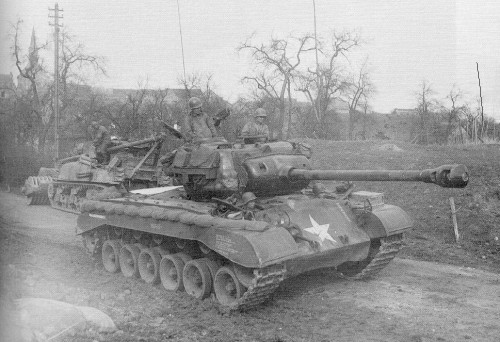
    A M26 Pershing in Korea

    Korean War Mail Delivery, M26 Pershing Style

    I found several references after that post including Kenneth Estes’ MARINES UNDER ARMOR: The Marine Corps ans Armored fighting Vehicles, 1916-2000 that had dates of Pershing Delivery varying from 21 July to 31 July 1945. It turns the 31 July 1945 date is correct and the landing craft tank (LCT) I mentioned were at Okinawa the whole time, not in a round trip convoy to Hawaii.

    The following story of the shipment of 12 Pershings to Okinawa is from PERSHING: A History of the Medium Tank T20 Series by R.P. Hunnicutt:
    Read the rest of this entry »

    Posted in History, Japan, Military Affairs, National Security, Okinawa 65, War and Peace | 2 Comments »

    Battle of Okinawa 65 Years Later — Revisiting and Summarizing

    Posted by Trent Telenko on 25th June 2010 (All posts by Trent Telenko)

    Print This Post Print This Post

    I ran across more data on the priority shipping CDL Tanks and deploying Recoilless Rifles for Okinawa that made some of the things I posted my here factually wrong. There was also additional information of the “VT” proximity fuse in US Army artillery.

    Taken together, what didn’t make it to Okinawa would amount to a technological surprise for the Japanese defending the beaches of Kyushu, had the A-bomb failed to get a surrender.
    Grant Canal Defense Light Tank

    The M3 CDL tanks were assembled at Rock Island Arsenal. Instead of a main gun turret the tank chassis mounted a steel box containing a 13 million candle power carbon arc lamp backed by mirrors to focus the beam, a machine gun and fake cannon. A 10Kw generator was mounted on the back and run by a power take off from the engine. The 75mm sponson gun was retained. Some 500 M3 CDLs were produced in 1943-44. Some 300 entered US Army service with a few used during the battle for the Ludendorff Bridge at Remagen, Germany. Eighteen CDL arrived on Okinawa in June 1945 after the fighting ended

    First, it turns out that the June 1945 arrival of the M3 Grant medium tank based “Canal Defense Light” (CDL) tanks was not based on a April 1945 emergency request during Okinawa fighting like the Pershing, but instead was due to a trip by a US Army Ordnance officer working for 10th Army to Washington DC months earlier.
    See below:

    ON BEACHHEAD AND BATTLEFRONT
    Chapter 23, pages 453-453

    What of New Weapons?

    Colonel Daniels thought good use could be made of Canal Defense Light tanks. The Japanese in their campaign in Malaya had successfully made end runs at night along the coast, landing tanks from boats, and could be expected to do the same thing along the coast of Okinawa. Against such attacks, the CDL’s with their blinding searchlights might be used to very good effect. General Buckner had never heard of the CDL’s but after having been furnished a description he gave Daniels permission for a flight to Washington to round up a company. When Daniels got to Washington, he found that all of these special tanks had gone to England for shipment to France, but that he might expect some in several months. Accordingly, he put in a request for about 18 or 20 CDL’s, and an officer and men trained in operating them. They did not arrive until late June 1945, after the Okinawa campaign was over.25
    .
    25. Ltr, Brig Gen Robert W. Daniels to Lida Mayo, 23 Nov 63, OCMH. When the CDL’s arrived Daniels got one ashore and showed it to Gen. Joseph W. Stilwell, who had succeeded Buckner as Commanding General of Tenth Army. Stilwell was impressed. Ibid.

    Read the rest of this entry »

    Posted in History, Japan, Military Affairs, National Security, Okinawa 65, USA, War and Peace | Comments Off

    Battle of Okinawa 65 Years Later — 21 thru 22 June 1945

    Posted by Trent Telenko on 22nd June 2010 (All posts by Trent Telenko)

    Print This Post Print This Post

    21 June 1945

    On Okinawa, the Japanese headquarters on Hill 89 is taken by the forces of the US 32nd Infantry Regiment, part of US 7th Division. The body of General Ushijima, commanding the Japanese 32nd Army is found nearby.

    Five hours after 10th Army commander USMC Major General Geiger declares Okinawa “Secure” the Japanese high command delivered its last kikusui or “Floating Chrysanthemum” suicide strike of the Okinawa campaign.

    Several Kamikaze slip through and strike ships at the at the Kerma Ritto anchorage. Sea Plane tenders Kenneth Whiting and Curtis are both struck and the Curtis is heavily damaged by fire.

    LSM-59 is hit and sunk towing the hulk of the decommissioned USS Barry, which is also sunk in the same attack. The Barry’s new mission was to be a kamikaze decoy, for which it succeeded sooner than intended.

    The 22 June 1945 flag raising signaling the end of organized Japanese resistance

    RAISING THE AMERICAN FLAG on 22 June denoted the end of organized Japanese resistance.

    22 June 1945

    The US Navy suffers a suicide strike on LSM-213 at Kimmu Wan. The landing ship suffers heavy structural damage with three killed and 10 wounded.

    At Nakagusuku Wan the beached LST-534 suffers a bow door strike from a Kamikaze with three killed and 35 wounded. The nearby USS Ellyson is near missed by a Kamikaze with one killed and four wounded.

    Radar Picket Station 15, with USS Massey and USS Dyson present, is heavily attacked, but the fighter cover killed 29 out of an estimated 40 attackers without damage to either ship.

    On Okinawa, the battle with organized ground forces has ended. The 10th Army starts a 10 plan to mop up remaining unorganized Japanese ground forces.

    American forces have lost 12,500 dead and 35,500 wounded.

    In the air, the American forces have lost 763 planes.

    The Japanese losses include 120,000 military and 42,000 civilian dead.

    For the first time in the war, there are a relatively large number of Japanese prisoners: 10,755.

    American reports claim the Japanese have lost 7,830 planes.

    Including today’s suicide strikes, the US Navy had 36 ships sunk and 368 damaged by the end of the Okinawa campaign.

    Okinawa Background — The Death of Generals Ushijima and Cho

    Read the rest of this entry »

    Posted in History, Japan, Military Affairs, National Security, Okinawa 65, USA, Uncategorized, War and Peace | Comments Off

    Battle of Okinawa 65 Years Later — 19 thru 20 June 1945

    Posted by Trent Telenko on 20th June 2010 (All posts by Trent Telenko)

    Print This Post Print This Post

    19 June 1945

    On Okinawa, the insistent use of propaganda by means of leaflets and loudspeakers, by the American forces, induces some 343 Japanese troops to surrender.

    Japanese forces fall back in some disorder along the frontage of the US 3rd Amphibious Corps but continue to resist along the line held by the US 24th Corps.
     FIGHTING TOWARD HILL 89, tanks of the 769th Tank Battalion attack a bypassed Japanese strong point on top of Yaeju-Dake, 18 June 1945


    FIGHTING TOWARD HILL 89, tanks of the 769th Tank Battalion attack a bypassed Japanese strong point on top of Yaeju-Dake, 18 June 1945

    20 June 1945

    On Okinawa, Japanese resistance along the center of the line, held by the US 24th Corps, continues to be strong.

    The US 32nd Infantry Regiment (US 7th Division) reaches Height 89, near Mabuni, where the Japanese headquarters have been identified.

    On the flanks, the American Marines on the right and the infantry on the left advance virtually unopposed, capturing over 1000 Japanese and reaching the southern coast of the island at several points.

    The scale of surrenders is unprecedented for the forces of the Imperial Army.


    Okinawa Background — Japanese Resistance Collapses

    Read the rest of this entry »

    Posted in History, Japan, Military Affairs, National Security, Okinawa 65, USA, War and Peace | 3 Comments »

    Battle of Okinawa 65 Years Later — 16 thru 18 June 1945

    Posted by Trent Telenko on 18th June 2010 (All posts by Trent Telenko)

    Print This Post Print This Post

    16 June 1945

    On Okinawa, Mount Yuza is captured by the US 381st Infantry Regiment. Fighting continues on the south of the island.

    At sea, the Japanese air offensive against American ships slackens, but the Japanese still sink 1 destroyer and damage 1 escort carrier.

    The destroyer, the USS Twiggs, was struck close to shore at twilight on bombardment duty by a low level torpedo plane. Her crew had 188 survivors with 126 men lost, dead and missing, including her captain.

    17 June 1945

    On Okinawa, reinforced American units advance in the Kuishi Ridge area which has been stubbornly defended by forces of the Japanese 32nd Army.

    Along the line of the US 24th Corps, the last Japanese defensive line is broken. The US 7th Division completes the capture of Hills 153 and 115.

    YUZA PEAK, under attack by the 382d Infantry, 96th Division. Tanks are working on the caves and tunnel system at base ridge of ridge.

    YUZA PEAK, under attack by the 382d Infantry, 96th Division. Tanks are working on the caves and tunnel system at base ridge of ridge.

    The commander of the Japanese naval base on Okinawa, Admiral Minoru Ota, is found dead, having committed suicide.

    18 June 1945

    On Okinawa, the remnants of the Japanese 32nd Army continue to offer determined resistance to attacks of the US 3rd Amphibious Corps and the US 24th Corps.

    Lt. General Simon Bolivar Buckner, commanding US 10th Army, is killed by Japanese artillery fire while he is on a visit to the front line, inspecting troops of the US 8th Marine Regiment.

    Buckner is temporarily replaced by USMC General Geiger, commanding the US 3rd Amphibious Corps.

    Okinawa Background — Processing the KUNISHI RIDGE with Recoilless Rifles

    Read the rest of this entry »

    Posted in Japan, Military Affairs, National Security, Okinawa 65, USA, War and Peace | 3 Comments »

    Battle of Okinawa 65 Years Later — 15 June 1945

    Posted by Trent Telenko on 15th June 2010 (All posts by Trent Telenko)

    Print This Post Print This Post

    15 June 1945

    On Okinawa, Marines suffer heavy casualties and are unable to advance on Kunishi Ridge. The US 1st Division, already short of troops, is attached to the US 2nd Marine Division.

    Forces of the US 24th Corps continue operations to eliminate Japanese positions on Mount Yaeju and Mount Yuza.

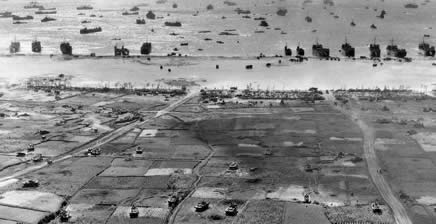
    Landing Vehicle Tracked (LVT)  on 01 April 1945

    Landing Vehicle Tracked (LVT) on 01 April 1945


    Okinawa Campaign Background -- LVT Attrition

    The USMC, at the beginning of the Okinawa campaign, had used previous island assaults as the base line for provisioning spares and supports for it’s landing vehicle tracked (LVT).

    It was utterly inadequate in the face of the reality of protracted combat on Okinawa:


    At the beginning of the campaign, the 4th and 9th Amphibian Tractor Battalions with a total of 205 LVTs were attached to the 6th Marine Division. Added to those in the 1st and 8th Battalions attached to the 1st Marine Division, the total number of LVTs available to IIIAC was 421. IIIAC AR, chap VII, p. 101. The resupply of spare parts for LVTs was totally inadequate, especially in the case of such vitally needed basic items as tracks, track suspension system parts, front drive assemblies, and transmission parts. The lack of all of these deadlined a good many LVTs and severely limited the amount of support they could have provided during the drive to the south and in the Oroku landing. At the end of the campaign, 75 LVTs had been completely destroyed as a result of enemy action, or, having been badly damaged, they were cannibalized for spare parts. Of the 346 vehicles remaining, 200 were deadlined for lack of spare parts. Ibid., p. 102.

    There were 421 LVT-3 and LVT-4 on 1 April 1945. By the end of the campaign only 146 of that 421 were operational. A number a hair under 35% of the original starting force.

    The logistical implications of those numbers for Operation Olympic in November/December 1945 were daunting.

    Posted in History, Japan, Military Affairs, National Security, Okinawa 65, Uncategorized, War and Peace | 3 Comments »

    Battle of Okinawa 65 Years Later — 12 thru 14 June 1945

    Posted by Trent Telenko on 14th June 2010 (All posts by Trent Telenko)

    Print This Post Print This Post

    12 June 1945

    On Okinawa, many of the Japanese naval infantry cut off in the Oruku peninsula, reduced to a pocket of about 1000 square yards, begin to commit mass suicide to avoid surrender.

    The US 1st Marine Division captures the west end of Kunishi Ridge during a night attack.

    The US 96th Division attacks Japanese positions around Mount Yuza and Mount Yaeju.

    13 June 1945

    On Okinawa, the Japanese resistance in the Oruku peninsula ends. The US 6th Marine Division records a record 169 Japanese prisoners as well as finding about 200 dead. (This is a large total when compared with previous numbers of Japanese prisoners reported.)

    The fighting continues to the southeast, especially in the Kunishi Ridge area where a regiment of the US 1st Marine Division suffers heavy casualties.

    The US 24th Corps uses armored flamethrowers in the elimination of the Japanese held fortified caves on Mount Yuza and Mount Yaeju and on Hills 153 and 115.

    Battle line on the Kiyan Peninsula, 10-19 June 1945

    Battle line on the Kiyan Peninsula, 10-19 June 1945

    14 June 1945

    On Okinawa, mopping up operations proceed on the Oroku peninsula.

    The troops of the US 3rd Amphibious Corps and the US 24th Corps continue to eliminate fortified caves held by Japanese forces on Kunishi Ridge and on Mount Yuza and Mount Yaegu.

    An American regiment of the US 96th Division reaches the summit of Mount Yaegu, while the US 7th Division extends its control of Hills 153 and 115.

    Okinawa Campaign Background — Goodbye General Mud
    Read the rest of this entry »

    Posted in History, Japan, Military Affairs, Okinawa 65, USA, War and Peace | Comments Off

    Battle of Okinawa 65 Years Later — 08 thru 11 June 1945

    Posted by Trent Telenko on 11th June 2010 (All posts by Trent Telenko)

    Print This Post Print This Post

    08 June 1945

    On Okinawa, in the north heavy fighting continues on the Oroku peninsula.

    In the south, the US 24th Corps prepares to attack Mount Yaeju.


    09 June 1945

    On Okinawa, the Japanese forces defending the Oroku peninsula are cut off and surrounded by forces of the US 6th Marine Division.

    The US 1st Marine Division advance southward to Kunishi Ridge, one of the last Japanese strong points.

    10 June 1945

    On Okinawa, fighting continues on the Oroku Peninsula, where the forces of the US 6th Marine Division have reduced the Japanese pocket to about 2000 square yards. Heavy Japanese losses are recorded in nighttime counterattacks.

    Meanwhile, on the south of the island, the US 1st Marine Division suffers heavy losses in the successful capture of a hill west of the town of Yuza.

    The US 24th Corps forces, to the left, launches a major offensive against the last Japanese defensive line, the Yaeju-Dake Line. Japanese resistance is evidently weakening.

    YAEJU-DAKE was brought under American artillery fire

    YAEJU-DAKE was brought under American artillery fire shortly before the infantry attempted its first advance to the escarpment. Burst at upper left is white phosphorus.

    Read the rest of this entry »

    Posted in History, Japan, Military Affairs, National Security, Okinawa 65, USA, War and Peace | Comments Off

    Battle of Okinawa 65 Years Later — 07 June 1945

    Posted by Trent Telenko on 7th June 2010 (All posts by Trent Telenko)

    Print This Post Print This Post

    07 June 1945

    On Okinawa, in the Oroku peninsula, Japanese forces hold attacks by the US 6th Marine Division while the US 1st Marine Division advances southward and isolates the peninsula defenders.

    The US 24th Corps is engaged in artillery bombardments.

    Okinawa Background — Colonel Unmacht’s 4.2 inch Mortar Gunboats

    A LCI(M) Off Okinawa photographed from the battleship USS West Virginia

    LVT amphibious tractors move past LCI(M)-809 (center), bound for the Okinawa landing beaches, 1 April 1945.

    The redoubtable Colonel Unmacht of Hawaiian flame throwing tank fame was also responsible for another major innovation in off-shore fire support in WW2 — the 4.2 inch Mortar Gunboat.

    They were simply LCVP, LSM and LCI landing craft given one to four 4.2 inch (107mm) mortars to provide fire support for landings. The inability of naval gunfire to hit reverse slopes and the short 1,200 yard range of naval 4.5 inch and 5 inch rockets means that the 3,500-4,500 yard range 4.2 inch mortar was ideal to hit the backs of hills and mountains fronting landing beaches.

    This is the time line of 4.2 inch gunboat development which supported not only the Central Pacific, but also General Mac Arthur’s SWPA command and the invasion of Sicily!

    1942 – Developing doctrine and experimenting
    July 1943 – Sicily
    Spring 1944 – Saipan, Marianas Group – aborted operation
    21 June 1944 – Bougainville, first successful amphibious combat operation
    August 1944 – Training in Empress Augusta Bay, Bougainville, Solomon Islands
    15 September 1944 – Peleliu, Palau Islands: first LCI(M) combat use
    20 October 1944 – Leyte, Philippine Islands
    9 January 1945 – Luzon, Philippine Islands
    19 February 1945 – Iwo Jima, Bonin Islands, northwest Pacific basin
    1 April 1945 – Okinawa, the Ryukyus Islands, northwest Pacific basin

    Read the rest of this entry »

    Posted in History, Japan, Military Affairs, National Security, Okinawa 65, USA, War and Peace | 1 Comment »

    Battle of Okinawa 65 Years Later — 05 thru 06 June 1945

    Posted by Trent Telenko on 6th June 2010 (All posts by Trent Telenko)

    Print This Post Print This Post

    05 June 1945

    On Okinawa, Japanese forces on the Oroku peninsula strongly resist the US 6th Marine Division which nonetheless captures most of the airfield.

    In the south the forces of the US 24th Corps near the last Japanese defensive line, running from Yuza in the west to Guschichan on the east coast and based on the three hills, Yaeju, Yuza and Mezado.

    Oroku and Yaeju-Dake, 4-11 June 1945

    Oroku and Yaeju-Dake, 4-11 June 1945

    At sea, a sudden typhoon damages 4 battleships, 8 aircraft carriers, 7 cruisers, 14 destroyers, 2 tankers, and and ammunition transport ship, of the US 3rd Fleet.

    Two Japanese Kamikaze attacks cripples both the WW1 era battleship USS Mississippi and the heavy cruiser USS Louisville.

    06 June 1945

    On Okinawa, elements of the US 6th Marine Division advance in the Oruka Peninsula following their landing. Naha airfield is secured.

    Elements of the US 96th Division (US 24th Corps) reach the lower slopes of Mount Yaeju and are halted by intensive Japanese fire.

    Okinawa Background — The T-6 Ritchie Device

    Read the rest of this entry »

    Posted in History, Japan, Military Affairs, Okinawa 65, USA, Uncategorized, War and Peace | 1 Comment »

    Battle of Okinawa 65 Years Later — 04 June 1945

    Posted by Trent Telenko on 4th June 2010 (All posts by Trent Telenko)

    Print This Post Print This Post

    04 June 1945

    On Okinawa, two regiments of US 6th Marine Division make landings on the Oroku peninsula in an attempt to outflank Japanese defensive positions.

    The landing of the 6th Mar Div and Elmination of the IJN Base Force

    The battle line on Oroku Peninsula, 4-13 June 1945

    However, this is the base area of the Japanese Navy on Okinawa. The local IJN commander, after at first obeying orders to retreat to the Kiyan line, dislikes his new position. He disobeys orders and has his troops reoccupy their original cave positions at Oroku.

    The 32nd Army papers over the mutiny by sending orders after wards approving this action.
    Read the rest of this entry »

    Posted in History, Japan, Military Affairs, Okinawa 65, USA, War and Peace | 7 Comments »

    Battle of Okinawa 65 Years Later — 02 thru 03 June 1945

    Posted by Trent Telenko on 3rd June 2010 (All posts by Trent Telenko)

    Print This Post Print This Post

    02 June 1945

    On Okinawa, mopping up continues as the US 6th Marine Division prepares to land two regiments on the Oroku peninsula.

    The US Army 77th Division and it’s supporting 706th tank battalion are pulled out of the line.

    The remainder of the Okinawa campaign will be fought by the 24th Corps 7th and 96th Divisions and the 3rd Amphibious Corps 1st and 6th Marine Divisions.

    03 June 1945

    On Okinawa, Japanese forces are isolated in the Oroku and Chinen peninsula.

    The 7th Division cuts across the base of the Chinen peninsula to the south east coast. It finds the peninsula almost devoid of Japanese troops.

    The Ninth Japanese “Floating Chrysanthemum” aerial suicide attack on American navy radar pickets begins.

    Okinawa Background — The Engineer Special Brigade

    Long time military wargamers — grognards — have long noted that the American military, and the US Army in particular, has always been very good at logistics. In the Cold War this was expressed as “Americans always love a technological solution.” Before the advent of highly technological military aviation, this was better expressed as “Americans always love a material and organizational solutions.”

    In World War 2, this habit of institutional excellence was best expressed in the form of the US Army Engineer Special Brigade.

    One of the little know facts of WW2 — thanks to post WW2 USMC PR campaigns — was that the US Army did more amphibious landings, did larger amphibious landings (See Normandy), faced tougher on-shore opposition (See German tank division counter attacks on beach heads at Sicily, Salerno and Anzio) and faced worse aerial opposition (Luftwaffe guided bombs in 1943 and the Japanese Kamikazes appeared first, with better pilots, lasting longer in worse geographic conditions in the Philippines at Leyte and Lingayen) than the US Marine Corps. More over, the US Army was better than the Marines when it came to providing supplies across the beach!

    Read the rest of this entry »

    Posted in History, Japan, Military Affairs, National Security, Okinawa 65, USA, War and Peace | 4 Comments »

    Battle of Okinawa 65 Years Later — 01 June 1945

    Posted by Trent Telenko on 1st June 2010 (All posts by Trent Telenko)

    Print This Post Print This Post

    01 June 1945

    On Okinawa, after the fall of Shuri Castle, General Mushijima orders the Japanese troops to withdraw southward, towards the Oroku peninsula and the hills of Yaeju, Yuza and Mezado in the extreme south of the island. There are reports of discontent among the Japanese troops, something previously unheard of in the Imperial Army.

    Elements of the US 1st Marine Division cross the Koruba river, south of Naha.

    The forces of the US Army 24th Corps pursue the retreating Japanese while elements mop up around Shuri.

    US Tank-Infantry Team in Action

    TANK-INFANTRY ATTACKS marked the battle for the escarpment. An armored flame thrower of the 713th Tank Battalion, protected by infantry against enemy satchel-charge attacks, sprays flame over a knob on the crest of the escarpment

    Okinawa Campaign Background — The Medium Tank Shortage

    Up until this point in the Central Pacific Theater of the Pacific War, the Japanese had only put up scattered 37mm anti-tank guns and 37mm armed Type 95 light light tanks against American M3 Stuart light tanks and M3 Grant and M4 Sherman Medium tanks.

    These operations were small in terms of tanks used and taught US Army Central Pacific tank unit commanders some very bad habits in terms of operating without close infantry support. This became apparent with the veteran 193rd Tank Battalion supporting the 27th Division at Kakazu on 19 April 1945. The 193rd lost 22 of 30 tanks engaged along with it’s battalion commander.
    Read the rest of this entry »

    Posted in Japan, Military Affairs, National Security, Okinawa 65, USA, War and Peace | 2 Comments »

    Battle of Okinawa 65 Years Later — 30 thru 31 May 1945

    Posted by Trent Telenko on 30th May 2010 (All posts by Trent Telenko)

    Print This Post Print This Post

    May 30, 1945

    On Okinawa, American forces reach Shuri, south of the former Japanese positions. Two battalions of US Marines reach the southeast edge of Naha.

    The Japanese withdrawl to the Kiyan Line

    The withdrawal of the 44th independent Mixed Brigade to the Kiyan line, 31 May 1945

    May 31, 1945

    On Okinawa, the US 6th Marine Division (part of US 3rd Amphibious Corps) encounters Japanese rearguards near Hill 46. Japanese forces pull out of Shuri.

    The Shuri Line has fallen!

    Read the rest of this entry »

    Posted in History, Japan, Military Affairs, Okinawa 65, USA, War and Peace | 1 Comment »

    Battle of Okinawa 65 Years Later — 21 thru 29 May 1945

    Posted by Trent Telenko on 29th May 2010 (All posts by Trent Telenko)

    Print This Post Print This Post

    The Abandonment of the Shuri Line

    May 21, 1945

    On Okinawa, US 3rd Amphibious Corps reports advances near the Horseshoe, Half Moon and Wana positions, on the western flank.

    On the east-side, US 7th and 96th Divisions (parts of US 24th Corps) attack near Yonabaru.

    Japanese forces begin to pull out of the Shuri Line.

    May 22, 1945

    On Okinawa, American forces enter Yonabaru and capture Conical Hill. Heavy rains begin that hamper offensive operations for the coming weeks.

    The positions on the left and right of the Shuri line are about to fall leaving the main defensive positions flanked. The Chiefs of staff of the 32nd Army’s main combat units hold a meeting that will determine the remainder of the Okinawa Campaign. The three options they discuss are:

    1) Encircle Shuri Castle and prepare a concentrated defense with the 50,000 remaining troops and long range guns. This proposal retained most of the Japanese heavy guns and artillery ammunition, but there are not enough cave positions in this area to shield all the remaining troops from American artillery.
    .
    2) The second option considered was to withdraw east from the Shuri line to the Chinen Peninsula. This was rejected due to poor roads that would hamper the withdrawal and had the same problem of the lack of cave positions plus a lack of stockpiles of food and ammunition.
    .
    3) The third options was to withdraw south and form a line across the Kiyan Peninsula. This option was chosen because there were enough cave positions with stockpiles of food and small arms ammunition to fall back on.

    May 23, 1945

    On Okinawa, after occupying Naha, the US 6th Marine Division (part of US 3rd Amphibious Corps) encounters heavy Japanese resistance to attempts to advance further south.

    Japanese aircraft begin a three-day series of strikes against the Allied naval forces around the island. This is the seventh kikusui or “Floating Chrysanthemum” suicide strike.

    Reverse slope of Warta Ridge, U.S. forces captured this position only 1,000 yards northwest of the Shuri command cave on 21-23 May

    Reverse slope of Warta Ridge, U.S. forces captured this position only 1,000 yards northwest of the Shuri command cave on 21-23 May

    Read the rest of this entry »

    Posted in History, Japan, Military Affairs, National Security, Okinawa 65, War and Peace | 2 Comments »

    The Battle of Okinawa 65 Years Ago Today — Sunday May 20, 1945

    Posted by Trent Telenko on 20th May 2010 (All posts by Trent Telenko)

    Print This Post Print This Post

    Sunday May 20, 1945

    On Okinawa, American troops secure Chocolate Drop Hill after fighting in the interconnecting tunnels.

    Elements of the 1st Marine Division, part of US 3rd Amphibious Corps, capture Wana Ridge.

    Elements of the US 6th Marine Division, part of the same corps, begin mopping up operations in the Japanese held caves of the Horseshoe and Half Moon positions. They use flame-throwers and hollow-charge weapons and seal off some Japanese troops.

    Japanese forces counterattack on the Horseshoe position suffering an estimated 200 killed.

    To the east, the US 7th and 96th Divisions, of US 24th Corps, continue to be engaged in the capture of Yonabaru.

    null

    Okinawa Campaign Background — Shuri Line Threatened!

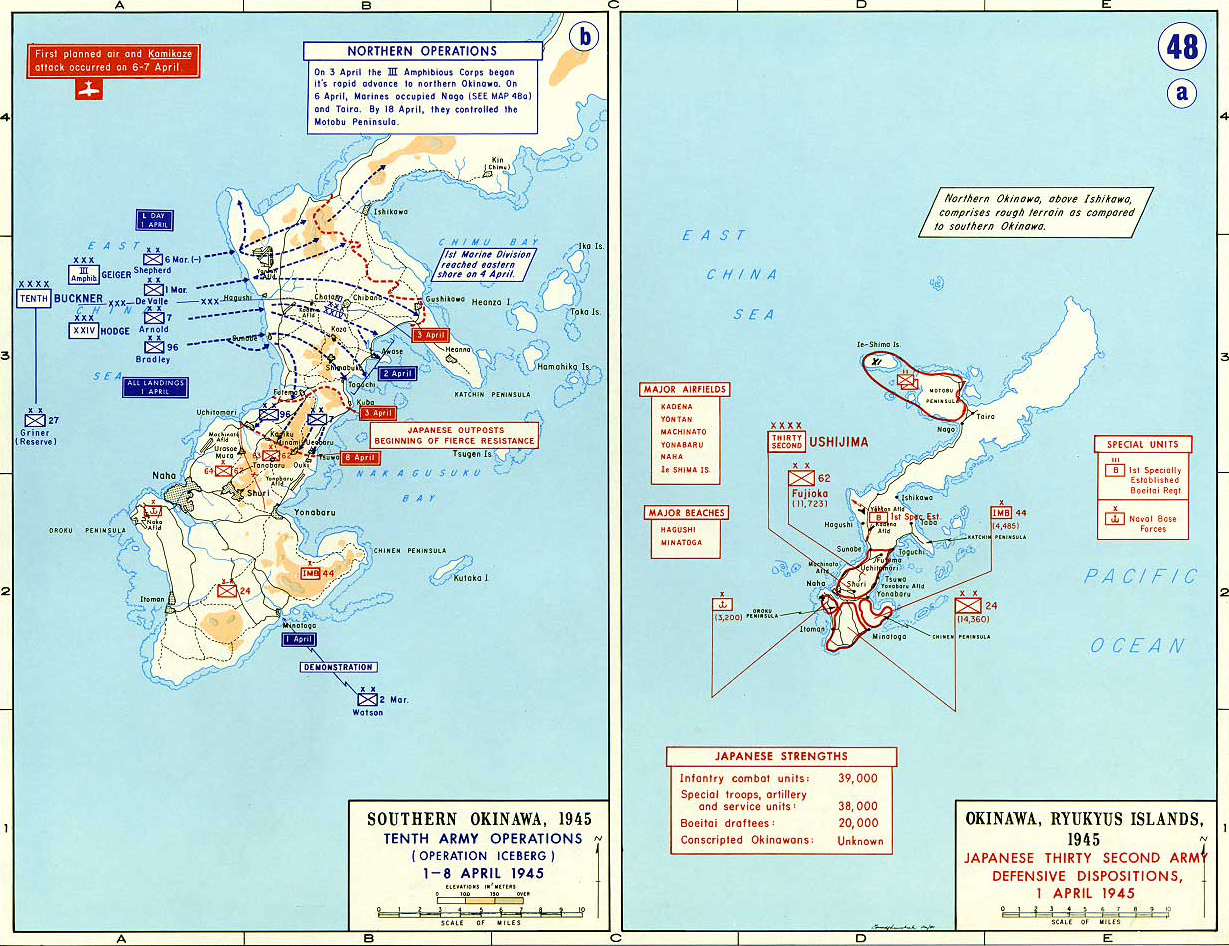
    The American 10th Army is into the tenth day of an offensive it resumed on 11 May 1945. The unrelenting American pressure of the “Blowtorch & Corkscrew” tank-infantry assaults has pushed the Japanese back close to 1/2 mile on the Shuri line over all and the Japanese are threatened with being flanked, if Yonabaru falls on the Okinawan East Coast.

    The failed Japanese general counter offensive by the on 4-5 May 1945 — where the 32nd Army lost 7,000 men out of it’s original 76,000, — has left the 32nd Army’s commander General Ushijima in a crisis and without reserves of troops and artillery ammunition to address it.

    American 10th Army intelligence is unaware of this development.

    Posted in History, Japan, Military Affairs, National Security, Okinawa 65, USA, War and Peace | Comments Off